ME360
Your body. In its entirety.
Most patient portals store results and stop there. They tell you almost nothing about what a number means, which part of the body it points to, or what makes it move. Me360 was built for the person who opens a result, sees one value slightly out of range, gets told to follow up, leaves with a prescription, and still knows nothing about how their body is working.
I take my health seriously and have always been curious about how the body works, so I built Me360 to solve that problem. It organizes a medical history around the body itself, explains every result in plain language, and then goes past the record to track whether the follow-up steps actually happened.
Role: Founder / Lead Product Designer
Tools: Claude Code, single-file HTML/CSS/JS, hand-drawn SVG charts, headless-browser verification
Overview:
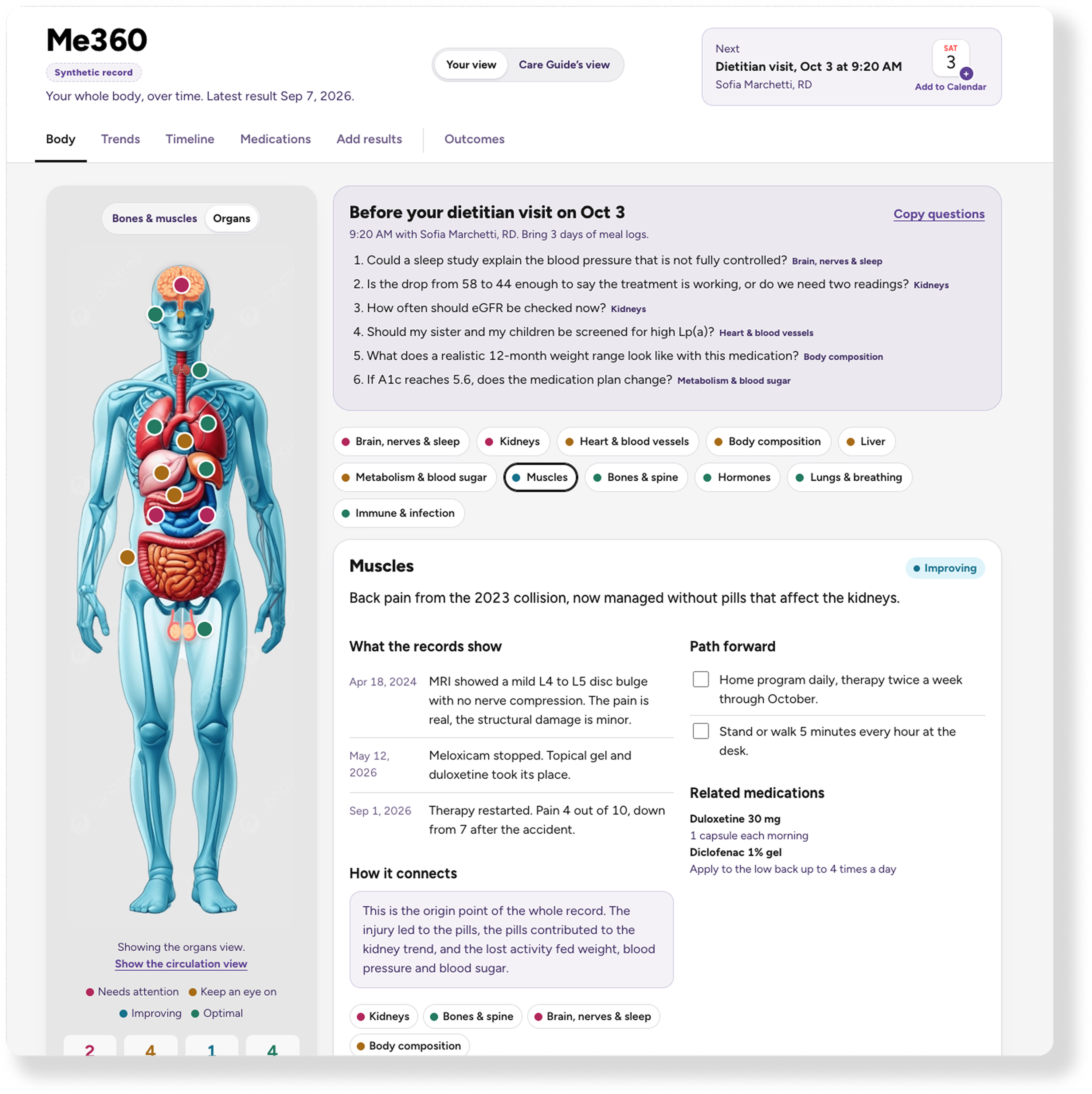
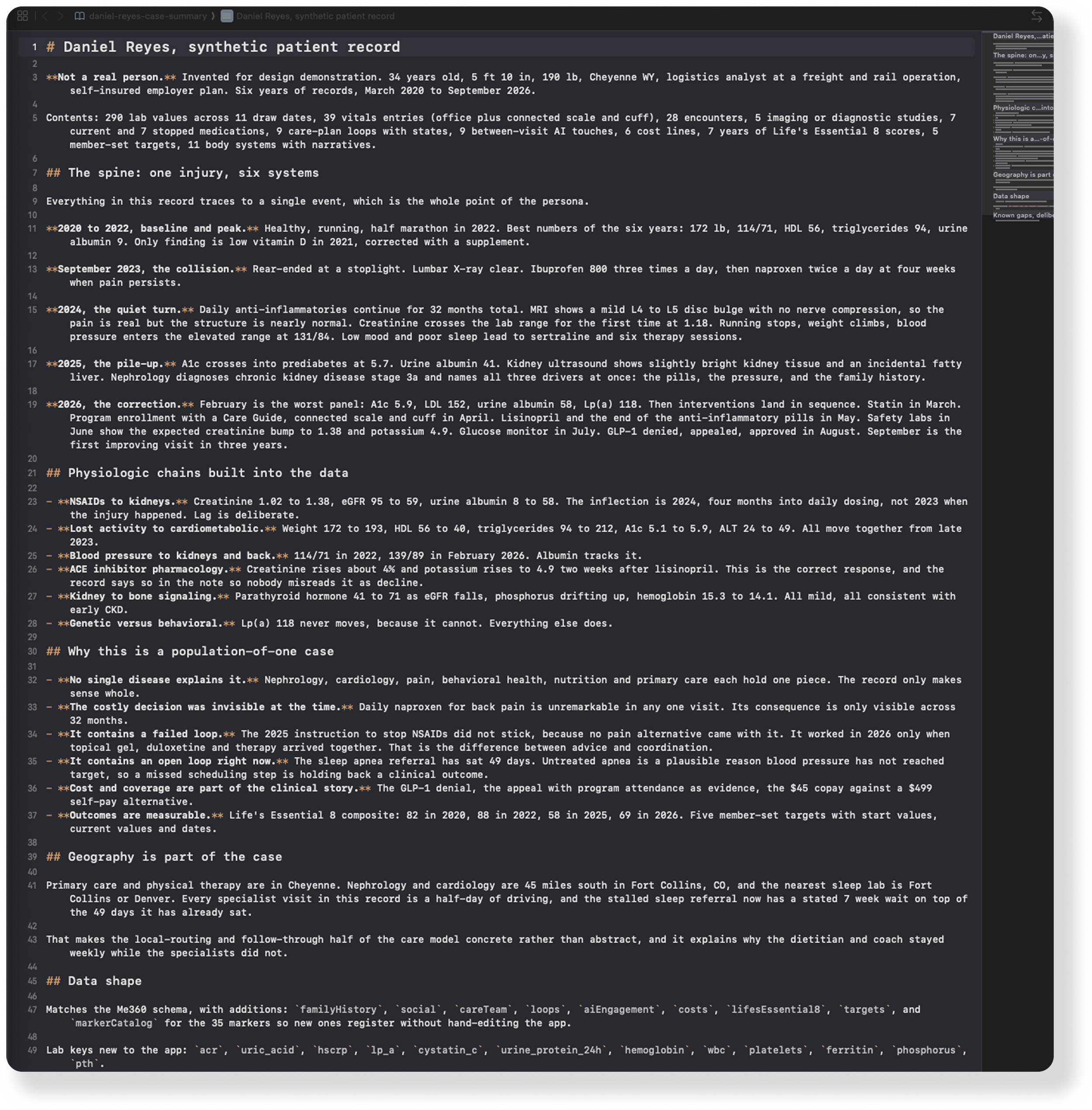
Me360 started as my own record and became a point of view. A record shows what happened. Care needs a loop. The app turns one person's history into eleven body systems over time, reads every result against the lab's own range, tracks who owns each follow-up step and whether anyone verified it happened, measures outcomes instead of app usage, and shows the same person's care from the coordinator's side. It runs as a single offline HTML file with a fully synthetic patient record.
Problem:
Closing the Comprehension Gap
For anyone managing an ongoing condition, the question is not what the results say. It is how they are doing and what comes next. Portals answer neither. Four gaps defined the brief:
The Context Void. A result shows up as a number and a range. Nothing tells you what it means, what moves it, or where it sits in how your body works as a whole. All of that context lives in your doctor's head, and the visit is twelve minutes long.
The System Blindspot. Results are grouped by the panel that produced them, not by the part of the body they came from. Nothing links a pain medication to a kidney value to a rising blood pressure, even when all three are the same story.
The Invisible Decision. Daily anti-inflammatory pills for back pain looked unremarkable at every single visit. Their consequence only shows up across 32 months.
Advice Is Not Follow-Through. Being told to stop those pills did not stick for eight months, because nothing replaced the pain relief. It worked only when a topical gel, a different medication and physical therapy arrived together. That is the difference between advice and coordination.
How it works:
The record was treated as a design material rather than a database. Four decisions carry the product:
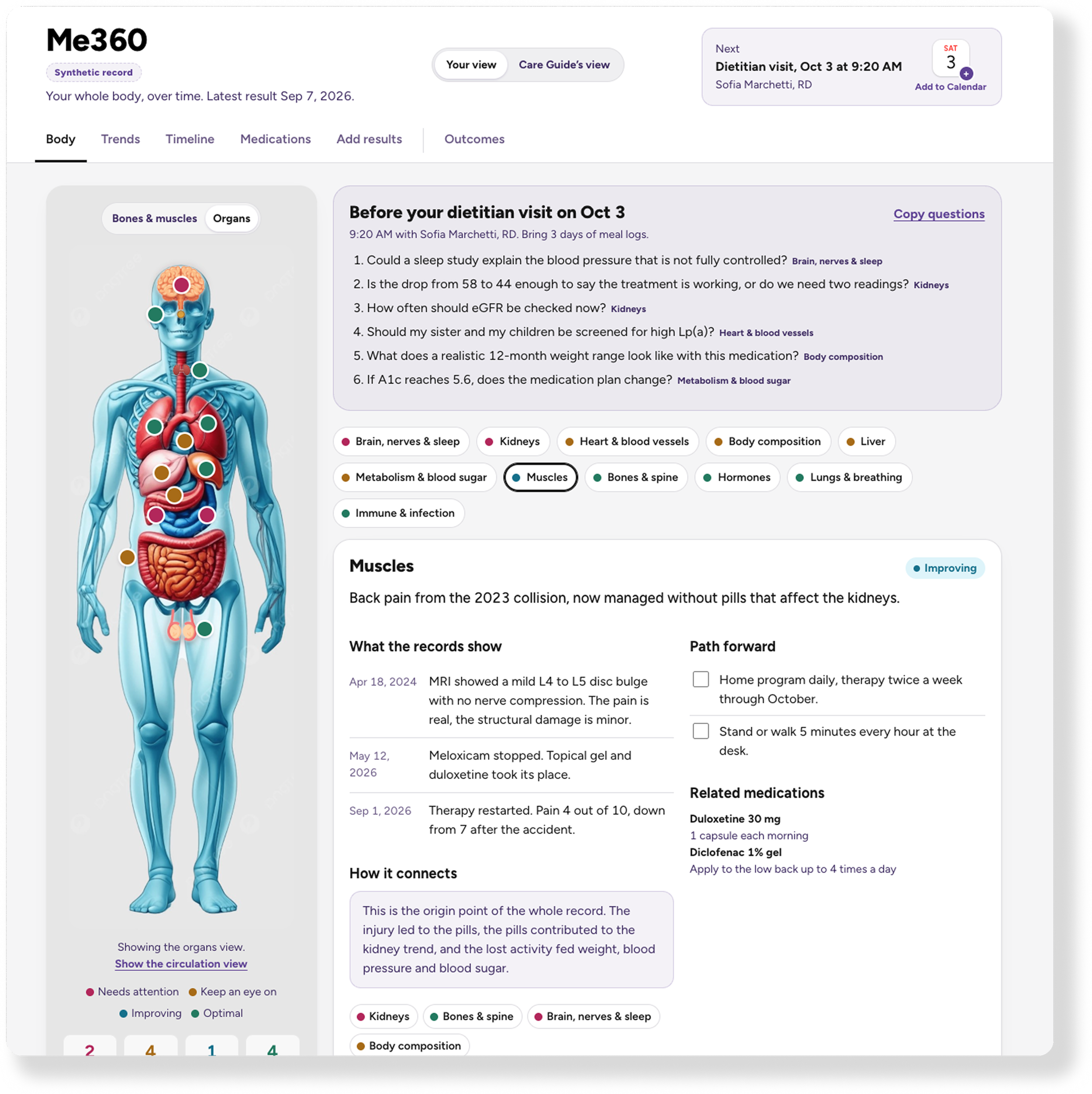
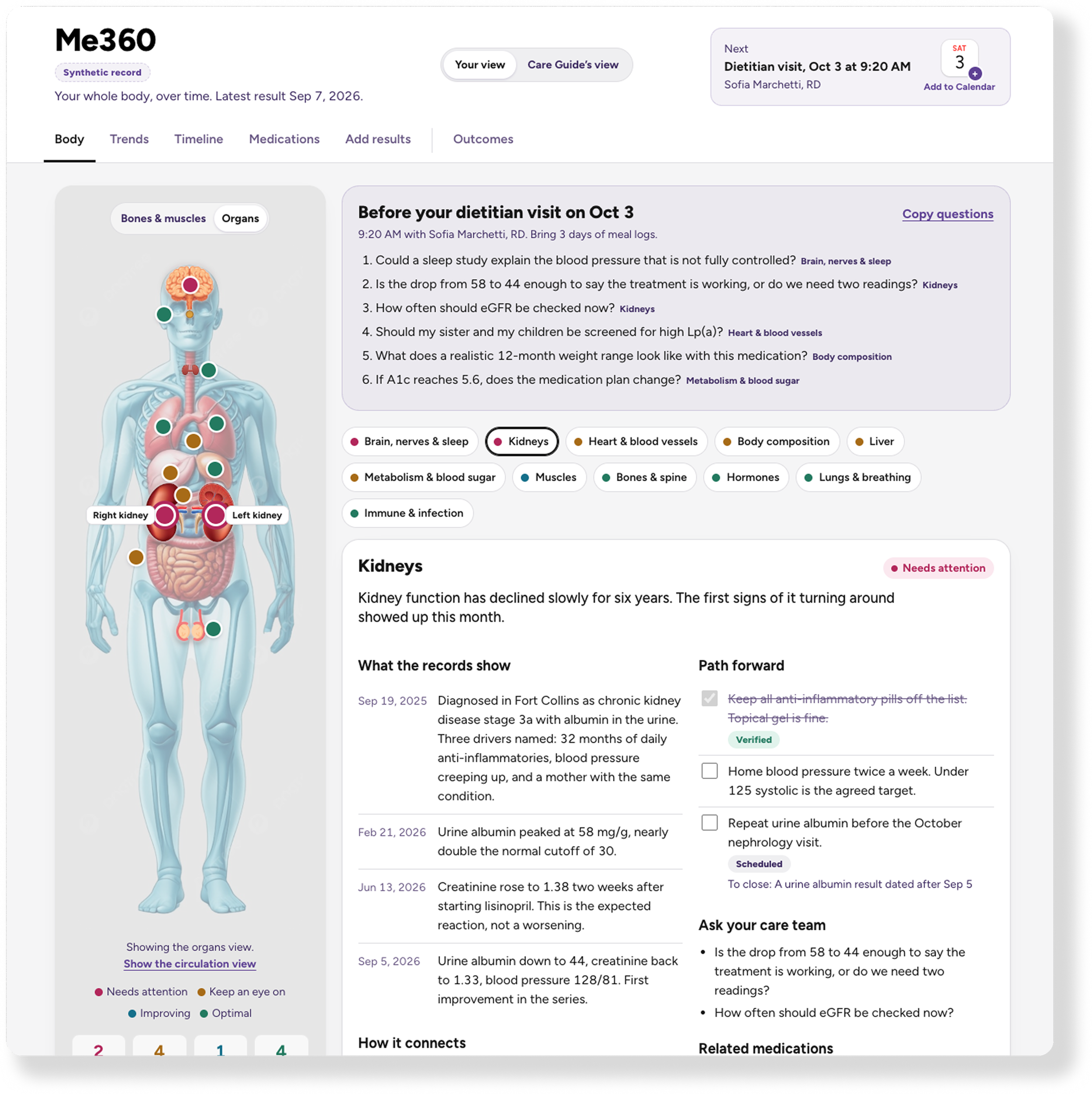
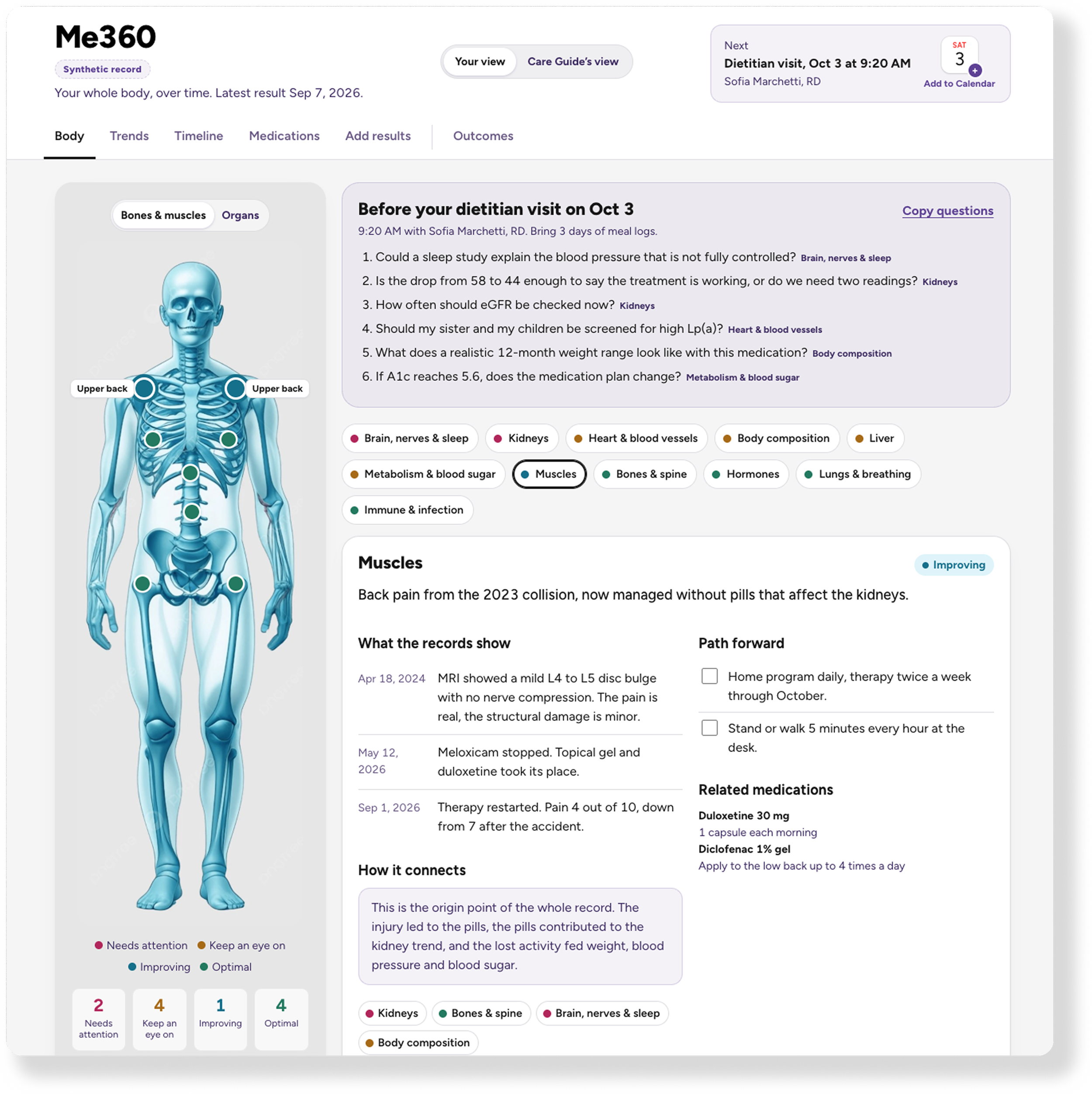
The body as a singular reference. I replaced the list of dates with a three-layer anatomical figure. One tab shows bones and muscles, the other holds organs and circulation and flips automatically to whichever illustration actually draws the organ you selected. Selecting kidneys fades the rest of the body back, because they sit behind everything else. Each system opens a plain-language headline, what the records show, how it connects to other systems, and questions to ask the care team.
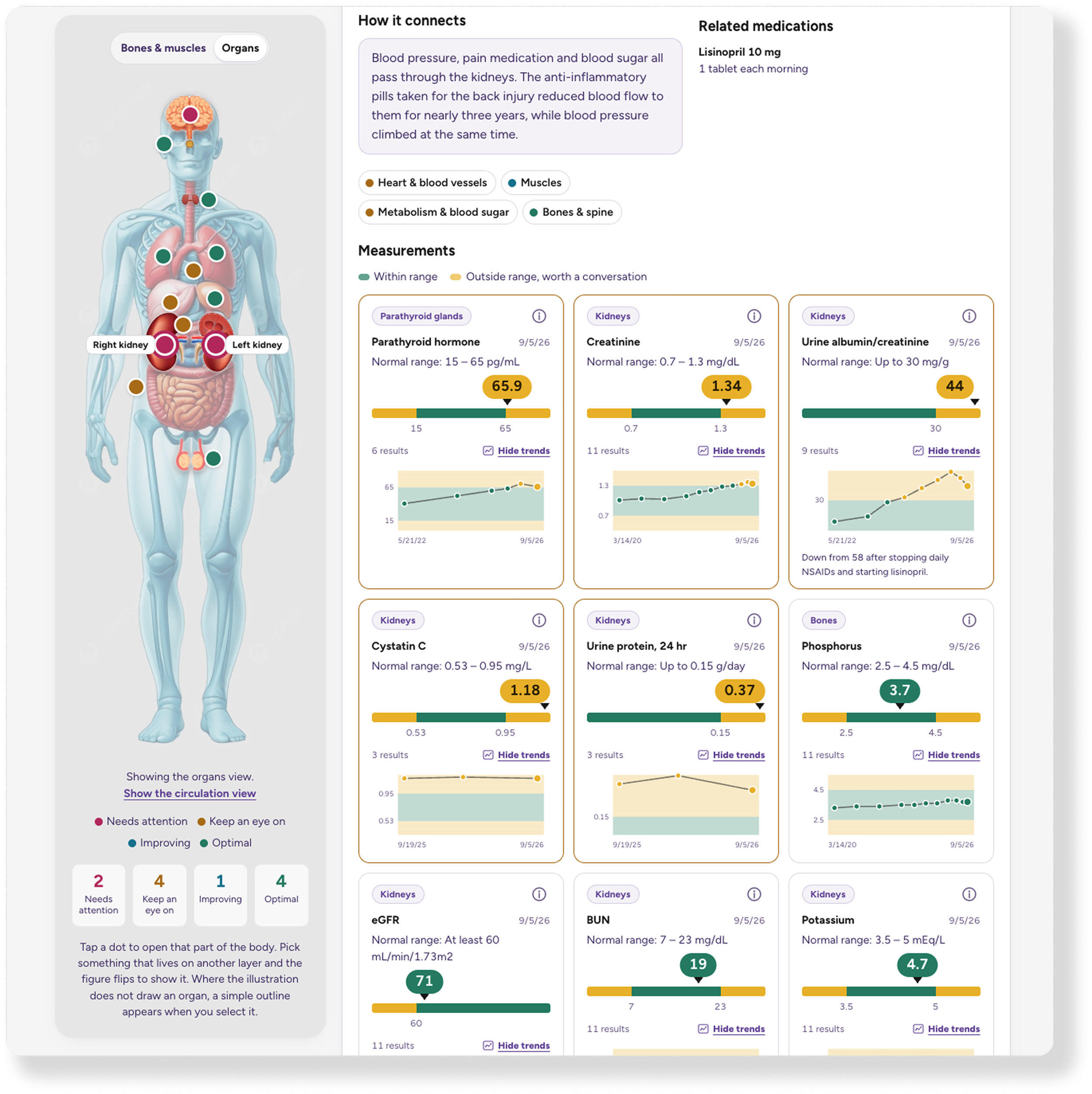
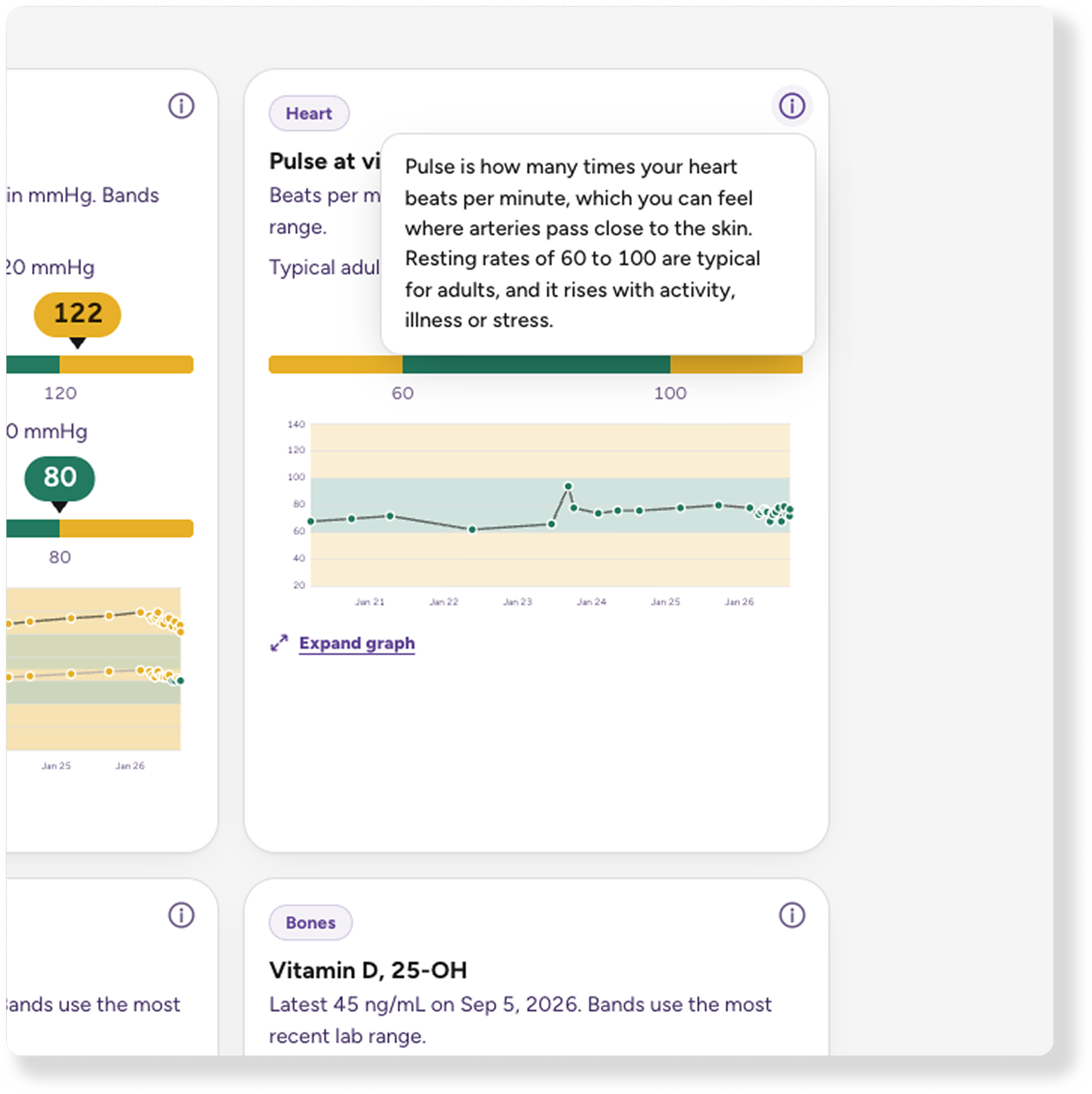
Every result explained in place. Each marker shows a value against the lab's own range, a trend chart open by default, an organ tag that pulls up every result for that organ, and an explainer describing what the test measures and where in the body it happens. Green means inside the range. Yellow means outside it and worth a conversation. Nothing else is color-coded, because a wall of color is not a signal.
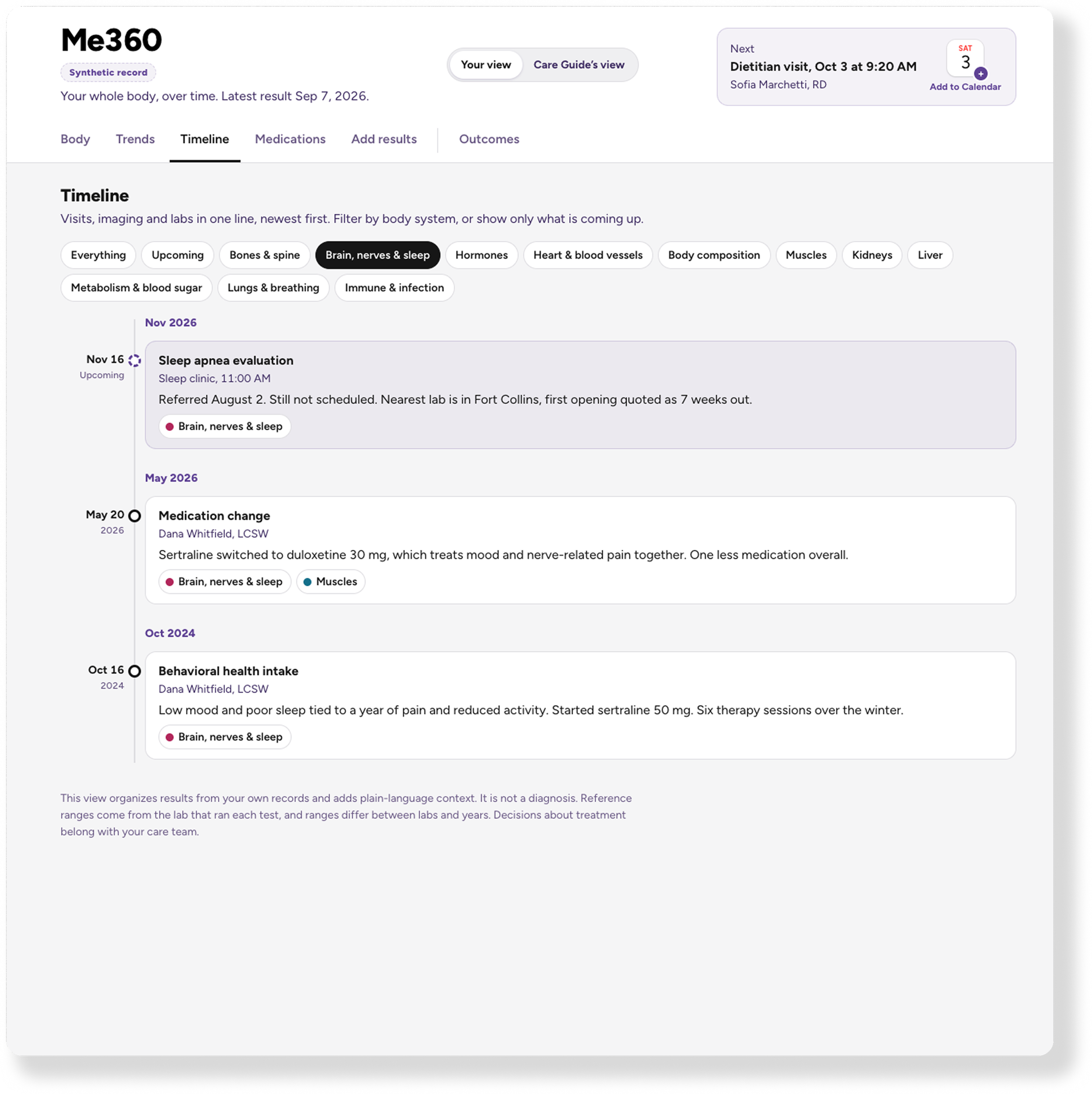
Loops instead of checkboxes. A follow-up step has an owner, a due date and a state, and it closes to verified only when matching evidence exists in the record. A lab, an appointment, a medication change, a note that was actually sent. Ticking a box marks it done and self-reported, shown differently on purpose. In the demo record, a sleep referral sits 49 days past due without anyone touching it, and untreated sleep apnea is a plausible reason blood pressure has not reached target.
Outcomes, not usage. The outcomes view computes every figure from the record, and each one opens the entries behind it. Markers that moved toward range, the gap between a risk first appearing in labs and anyone responding, follow-through on loops, miles driven and dollars paid. It ends with an explicit list of what it cannot compute from this record.
What I Learned:
A RECORD IS NOT A LOOP!
The data was never missing. What was missing was the connective tissue between values, and building that turned out to be a modeling problem rather than a visualization one. Deciding that a pain medication belongs in the kidney story is the design work. The charts are the easy part.
The bigger shift came later. I had built a record, and a record only shows what already happened. Care is a loop that anticipates, routes and verifies. Once I saw that, almost everything I added afterward was about closing loops rather than displaying data, including designing for the human coordinator instead of only the person holding the phone.
The third lesson is restraint. The strongest moments in Me360 are where it refuses to overstep. It shows an observed sequence instead of claiming a cause, names what it cannot see, and hands you a question instead of an answer. When confident wrong output is dangerous, knowing where the product stops is the design.
The Outcome:
11 body systems on a three-layer anatomical figure, with connected-system mapping and plain-language context
About 37 charts generated automatically, each drawn against its marker's own reference range
A loop engine where follow-up steps close on evidence, not on a checkbox, and self-reported is visibly different from verified
An outcomes view where every number traces back to the record entries behind it
A coordinator's lens on the same person's care, including a redaction block showing what a coordinator deliberately cannot see
A one-page service blueprint of the GLP-1 journey where, of roughly 30 service cells, 4 are covered today, 14 could be, and 12 belong to a care organization and are not mine to build
One self-contained HTML file, no framework, no server, opens offline by double-clicking
Working With AI:
Where It Helped and Where It Didn't
I set the concept, principles, persona, art direction and every acceptance decision. Claude Code wrote the implementation, about 1,100 lines plus embedded data, across two days of conversational direction. It was a fast, tireless engineer and auditor. It was not a designer, and twice it was confidently wrong.
It reported work as done without ever seeing it.
The Failure: The organ reveal was in the file and invisible on screen, because each outline was drawn directly underneath its own pin. Claude had read the code, confirmed the change, and moved on. My eyes caught it, not the model's.
The Correction: We stopped trusting the code as evidence. Claude started driving the real page in a headless browser and taking screenshots, so every claim of completion came with something to look at. That one change caught more issues than any amount of code review.
It implemented a wrong idea faithfully.
The Failure: I asked for a coordinator view, and Claude built a six-person caseload into a single-patient health app. It was well made and it broke the product's premise, and the model never questioned the request.
The Correction: I rewrote it as a one-patient lens on the same record. AI will happily build the thing you asked for. Noticing that the thing you asked for contradicts the product is still the human's job.
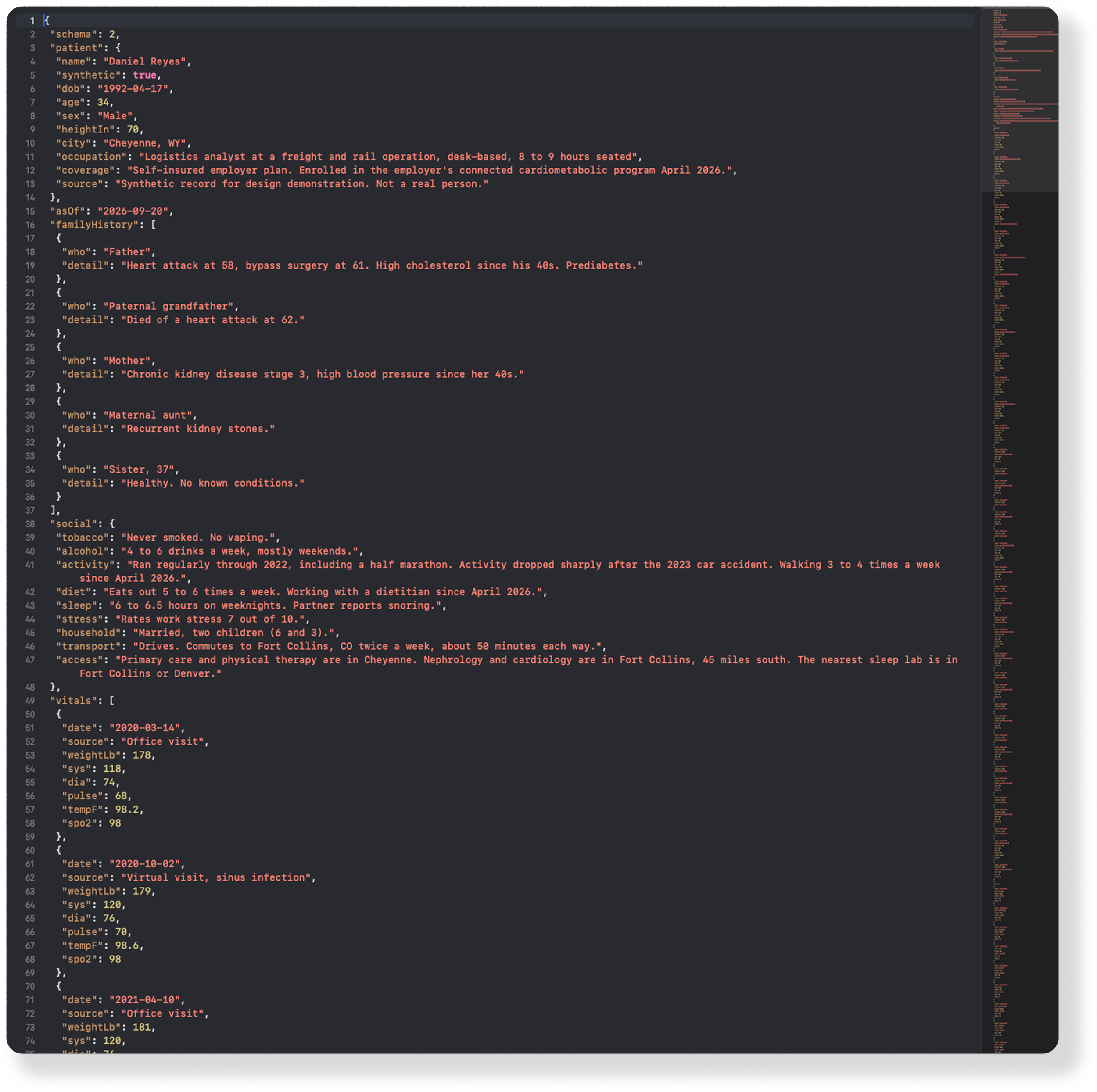
Where it genuinely earned its place: a measured design audit that found a 15-step type scale, roughly 20 padding variants and undersized tap targets, then collapsed them into a 7-step ramp and three tokens. It also caught real contradictions in my own demo data, including a kidney stage that did not match the lab values, and surfaced them to me instead of quietly correcting them.
What it could not do: judge taste, hierarchy or feel. The range convention, the score card as the hero, when a chart is too dense to read, the call that a caseload was the wrong idea. All corrections, none of them model ideas.
CHECK IT OUT!
Me360 PROTOTYPE:
The prototype below is a working health record built around six years of one patient's results. It covers the layered body figure, the charts, the follow-up tracking, the outcomes view and the coordinator's view.
Click around, it's a working build, not a static mockup.
•• The patient is invented. No real medical data appears anywhere in the app.
See More AI-Orchestrated APPS